
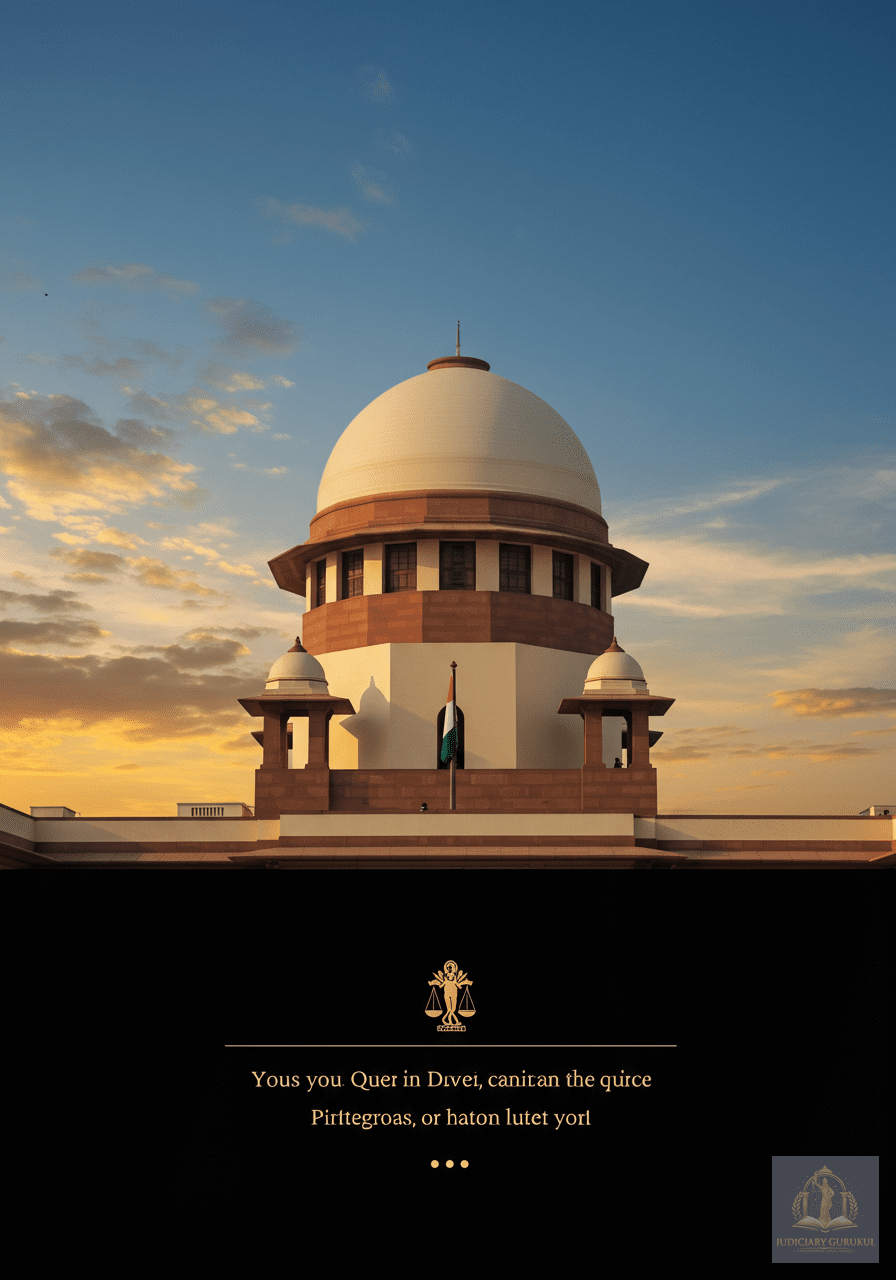
India’s apex court will now have 38 seats on the Bench. On 16 May 2026, President Droupadi Murmu, in exercise of powers under Article 123 of the Constitution, promulgated the Supreme Court (Number of Judges) Amendment Ordinance, 2026. The ordinance amends Section 2 of the Supreme Court (Number of Judges) Act, 1956, substituting the existing ceiling of 33 judges (excluding the Chief Justice of India) with 37. With the CJI included, the total sanctioned strength of the Supreme Court now stands at 38, up from 34. Six days later, on 22 and 27 May 2026, the Supreme Court Collegium recommended five names to fill the freshly created vacancies. For every Judiciary Gurukul aspirant — whether sitting BPSC 33rd on 3 June, prepping for UP HJS Mains in August, or building the Constitutional Law section for RJS 2026 — this is the single most important current-affairs item of the fortnight.
1. What the Ordinance Actually Does
The Supreme Court (Number of Judges) Act, 1956 is the parent statute that fixes the working strength of the Court. Section 2 had, until last week, capped the number of judges (other than the CJI) at 33. The 16 May 2026 ordinance substitutes “33” with “37” in Section 2. That is the entire textual change. But the consequences cascade.
According to PIB, the Union Cabinet had approved the proposal on 5 May 2026, citing pendency before the Supreme Court that stood at 93,143 cases as of 31 March 2026. Disposal capacity has plateaued; backlog has grown. Increasing the Bench from 34 to 38 means three additional Constitution Benches can be constituted simultaneously, or routine matters can be heard by more Division Benches in parallel.
2. Article 123 — The Constitutional Route Used
Why an ordinance and not an Act? Parliament was not in session. Under Article 123(1), when both Houses are not in session and the President is satisfied that circumstances render it necessary to take immediate action, an ordinance carrying the force of law may be promulgated. Article 213 gives the Governor a parallel power at the State level.
Three timing constraints apply to every Article 123 ordinance:
- It must be laid before both Houses when Parliament reassembles.
- It ceases to operate six weeks after the date of reassembly, unless converted into an Act or disapproved by resolution.
- The same subject matter cannot be re-promulgated in a manner the SC has repeatedly held to be a “fraud on the Constitution” (DC Wadhwa 1987; Krishna Kumar Singh 2017).
For PCS-J Mains aspirants this is textbook material. Expect a 10- or 15-mark question on the ordinance route in the next year’s Constitutional Law paper.
3. Collegium’s Five Recommendations (22 & 27 May 2026)
Once the strength was raised, the Collegium met twice in eight days to fill the gap. Per reportage on Bar and Bench, five names were recommended:
- Justice Sheel Nagu — Chief Justice, Punjab & Haryana High Court
- Justice Shree Chandrashekhar — Chief Justice, Bombay High Court
- Justice Sanjeev Sachdeva — Chief Justice, Madhya Pradesh High Court
- One additional sitting High Court Chief Justice (fourth name pending notification)
- Senior Advocate V. Mohana — direct elevation from the Bar
Four sitting Chief Justices plus a direct Bar elevation is a deliberate signal. The Collegium is using the expansion to address chronic complaints about insufficient women representation and limited Bar-to-Bench mobility. V. Mohana is among the few Senior Advocates with sustained Supreme Court appellate practice to be considered for direct elevation in recent years.
4. The Collegium System — Quick Refresher
Aspirants must remember that appointments to the Supreme Court are governed by the Collegium system, not by a statute. The system was crystallised through the Three Judges Cases:
- SP Gupta v. Union of India (1981) — First Judges Case — held executive primacy.
- SCAORA v. Union of India (1993) — Second Judges Case — reversed; CJI’s opinion to have primacy; Collegium of CJI + two senior-most judges.
- In re Special Reference No. 1 of 1998 — Third Judges Case — expanded Collegium to CJI + four senior-most judges.
- SCAORA v. Union of India (2015) — Fourth Judges Case — struck down the 99th Amendment and the NJAC Act, restoring the Collegium.
The Government’s role is residual: it can return a recommendation once for reconsideration. If the Collegium reiterates, the recommendation is binding.
5. Why Pendency Drives This Reform
Quoting the Supreme Court of India registry data: pendency at 93,143 cases (31 March 2026) is the highest in the Court’s history. Disposal numbers have improved year on year, but filings have outpaced disposals since the late 2010s. The 1956 Act began with 10 judges. It has been amended to expand strength to 14 (1960), 18 (1977), 26 (1986), 31 (2008) and 34 (2019). The 2026 amendment is the seventh expansion — and the second in seven years.
The Supreme Court Observer reports that the immediate operational gain is the ability to constitute two additional Constitution Benches without disrupting existing Division Bench rosters — important given pending references on the Aligarh Muslim University minority status, the Article 370 review, the same-sex marriage curative, and the Sabarimala 9-Judge reference that reserved verdict on 23 May 2026 (covered in our Sabarimala explainer).
6. Impact on PCS-J Preparation
For your current-affairs paper, lock in these data points:
- Date: Ordinance promulgated 16 May 2026.
- Author: President Droupadi Murmu under Article 123.
- Parent Act: Supreme Court (Number of Judges) Act, 1956.
- Change: Section 2 — judges (excl. CJI) raised from 33 to 37.
- New Strength: 38 (including CJI).
- Pendency Trigger: 93,143 cases as of 31 March 2026.
- Collegium Action: 5 names recommended (22 & 27 May 2026).
For Constitutional Law Mains, prepare a 250-word answer on: “Critically examine whether expanding the Supreme Court’s sanctioned strength can address pendency, or whether the deeper problem lies in case-management and lower-judiciary capacity.” Use the All India Judges Association line and recent Law Commission references — both are covered in our T-8 Sprint Plan.
7. The Bigger Picture — Bills That May Follow
An ordinance is short-lived. Within six weeks of Parliament reassembling, the Government must introduce a Bill to convert this into an Act. Watch for the Supreme Court (Number of Judges) Amendment Bill, 2026 in the Monsoon Session. Parallel reform proposals on which the Government is reportedly working include a dedicated Constitution Bench at the SC and All India Judicial Service (AIJS) recruitment — covered in our recent constitutional-litigation explainer and the upcoming AIJS deep-dive on Judiciary Gurukul.
8. Practice Quiz — Lock the Numbers In
Ten MCQs on the ordinance, Article 123, the Collegium and the underlying jurisprudence:
Practice Quiz — 10 Judiciary Exam-Style Questions
Click an option to reveal the answer and explanation.
9. Frequently Asked Questions
Q1. Will the ordinance lapse if Parliament does not ratify it?
Yes. Under Article 123(2)(a), the ordinance ceases to operate six weeks after Parliament’s reassembly unless converted into an Act or disapproved by resolution. The Government is expected to introduce the Supreme Court (Number of Judges) Amendment Bill, 2026 in the Monsoon Session.
Q2. Can the Collegium recommend more than five names?
Yes. The five May 2026 recommendations fill the immediate four vacancies created by the ordinance plus one anticipatory vacancy. Further names can follow as retirements occur.
Q3. How is the ordinance route different from the AIJS proposal?
The ordinance only changes the headcount of SC judges. The All India Judicial Service is a separate, unimplemented reform under Article 312 that would create a centralised recruitment process for State subordinate judiciary.
Q4. Is the increase in SC strength constitutionally challengeable?
Unlikely. The SC has consistently held that the legislature (and the President by ordinance) is free to fix sanctioned strength; only the manner of appointment is constitutionally constrained by the Collegium framework.
Q5. Where can Judiciary Gurukul aspirants discuss this with faculty?
Our Constitutional Law mentors are available on 7033005444 daily from 9 AM to 9 PM for one-on-one doubt sessions on the ordinance, the Collegium and Article 123/213 jurisprudence.
Sources
- Press Information Bureau — Cabinet Approves Increase in SC Judge Strength
- Bar and Bench — President Promulgates Ordinance to Increase SC Judge Strength to 38
- Supreme Court Observer — Ordinance Lifts SC Strength to 38
- Supreme Court of India — Official Website
Disclaimer: This explainer is for examination preparation. For statutory text, consult the gazette notification published on egazette.gov.in.